The "Wuthering Heights" Problem: When Books Are Unadaptable
By Anwen Marshall
Across my entire literary experience, there has been no book that I have crossed paths with more than Emily Brontë’s Wuthering Heights. After spending most of my teens with little to no interest in books, this was the novel I chose to reintroduce myself to literature, consequently spending four, long months engrossed in the woes of these characters. Wuthering Heights cannot be called a perfect novel even by such an admirer as myself; it left me feeling exceedingly miserable, and the family tree gave me a headache – two Catherines and the name Linton Heathcliffe haunted the whole experience. Still, I give Brontë full credit for reigniting my interest in literature, and throughout my English degree, my journey with Wuthering Heights has continued. In fact, in the same week that I studied the text for a first-year module, Emerald Fennell announced that Margot Robbie and Jacob Elordi would be the leads in her own adaptation of the classic. Literary outcry ensued. But however much I wanted to join this condemnation, I couldn’t help but look to earlier film adaptations of the novel, which were likewise full of inaccuracy after inaccuracy, problem after problem. I could not find a single film adaption of Wuthering Heights that I might deem truly representative of the novel.
My opinion on the debate of adaptability comes from an unexpected place: my annual re-watch of The Lord of the Rings trilogy, including all its appendices. I am always struck by the creators’ discussions on adapting such a complex series— a feat many, quite logically, assumed to be impossible. You couldn’t call the film series strictly accurate to the books: characters and plotlines are cut, altered, or rearranged. Unsuccessfully received book-to-film adaptations are often critiqued for these same reasons. Yet The Lord of the Rings trilogy has been warmly regarded as a success, both by die-hard fans and newcomers to the story. How can a film so different from its source material be so well-received– and what makes this trilogy so different between every adaption of Wuthering Heights?
At the beginning of the appendices, the creators of The Lord of the Rings discuss the difficulties of adaptation. Books, and especially older classics, are seldom intended to appear on the big screen and therefore must utilise different methods of storytelling. Therefore, elements of the story must be altered to create a functioning film. It is the choice of these elements that determine whether an adaptation succeeds or fails. Evidently, I believe that The Lord of the Rings succeeded in its choices, while every Wuthering Heights adaptation has yet to strike a balance.
Before I begin what can only be described as a rant, I’d like to take a moment to praise the strong points across most Wuthering Heights adaptations. The setting of the moors—the wilderness where social boundaries and expectations are stripped away—is consistently well-presented, appearing just as misty and jagged as the landscape Brontë describes. I also appreciate the levels of passion most actors achieve in these roles: it is no easy task to portray the all-too complex relationship between Cathy and Heathcliffe. This praise goes particularly to my favourite adaptation, the 2009 mini-series starring Charlotte Riley and Tom Hardy. Although Riley expertly captures Cathy’s childish, emotionally grating charm, it is Hardy’s complex portrayal of Heathcliff that struck me most. Although Hardy is not a perfect casting, for reasons I will mention later, I believe that his acting best embodies Heathcliff, as he masterfully shifts from a sympathetic, persecuted character to a self-destructive tyrant.
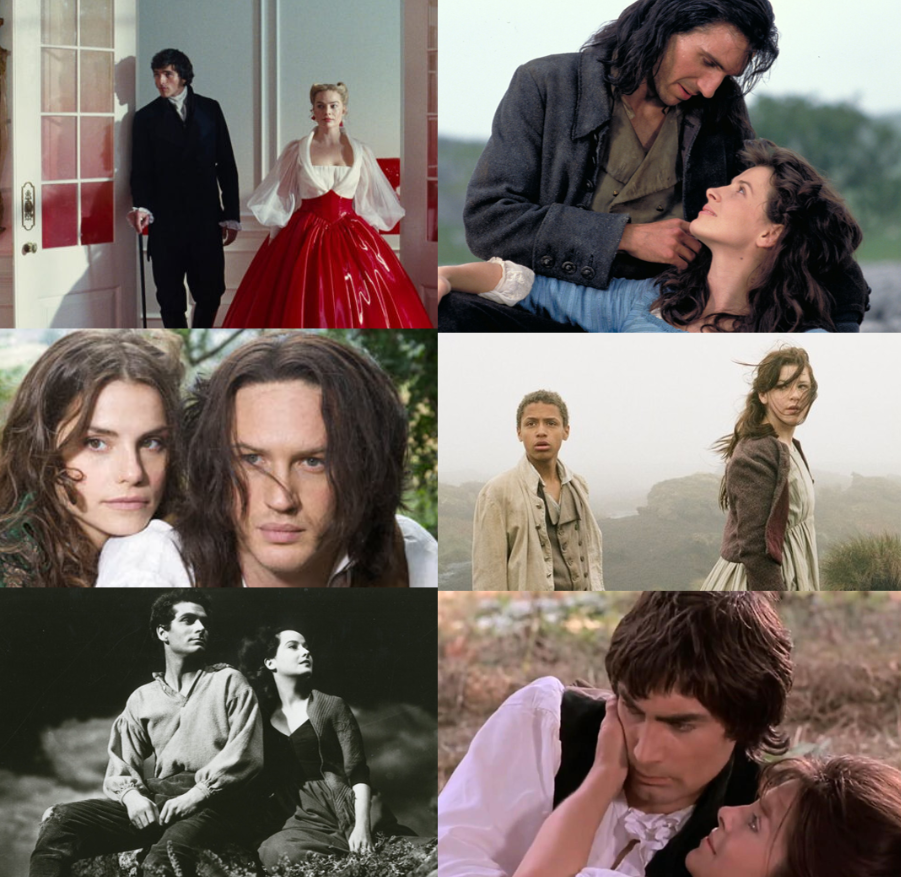
Image Credit (Left to Right, Top to Bottom): Emerald Fennel, “Wuthering Heights” (2026). Peter Kosminsky, Emily Brontë's Wuthering Heights (1992). Coky Giedroyc, Wuthering Heights (2009). Andrea Arnold, Wuthering Heights (2011). William Wyler, Wuthering Heights (1939). Robert Fuest, Wuthering Heights (1970).
Having already run out of examples to praise, I will now consider the long list of elements that adaptations have changed for the worse. Most of this criticism centres on my least favourite adaptation, which is Fennell’s own “Wuthering Heights.” These quotations marks, which Fennell rightfully includes in the title, are the only two things that held my sanity together in this over-two-hour-long piece of monotonous, shallow, grotesque erotica.
One could say, I was not a fan.
Resembling the original novel in little more than the characters’ names, the film left me with no lasting impression than that of a deep disgust towards eggs, fish, and finally, my own skin. Quite impressively, Fennell’s adaption managed to combine everything that frustrates me about Wuthering Heights into a single film. But—to prevent this from becoming a singular rant on this butchered attempt of a story—I will redirect to discuss these problems across all Wuthering Heights adaptations. While it feels impossible to provide a complete list, there are three major issues that have barred any adaptation from reaching success. Even my favourite version contains two-thirds of these issues, displaying the dire state in which these adaptations stand.
The first, and most grievous, is the unexplainable tendency to adapt only the first half of the novel and to exclude its framing narrative—I can name one, maybe two times that I’ve seen poor Mr Lockwood included at all. As one might expect, cutting out half of a story has its negatives: in this case, viewers miss the whole point of the novel. The second generation of characters displays the lasting impact of the first’s mistakes; generational trauma causes the second generation to mirror conflicts, until the cycle is finally broken. Without this inclusion, the narrative is unfairly diminished into the toxic love story of two genuinely insufferable people, whom we are somehow supposed to root for. I would not even call Wuthering Heights a love story; the relationship between Cathy and Heathcliffe is one of obsession and emotional reliance, rather than anything romantic.
The second leads issue is the tendency to age the characters. This may not seem like such a punishable offence, and I understand why most directors choose this: if you want to create a tragic and passionate romance, it’s unlikely that you would cast fourteen-year-olds. Honestly, I wouldn’t find huge issue with this change if directors changed the characters’ personalities alongside their ages. But that is never the case. In a sudden urge to be faithful to the book, adult actors are given the dialogue and personality traits of their fourteen-year-old counterparts. Even worse, this tendency is much more visible in portrayals of Cathy than Heathcliff, whose brooding presence communicates slightly more maturity. In contrast, Cathy appears as the irrational and irritable child she was always intended to be. I cannot stress my discomfort with this enough—the infantilisation of female romantic leads always leaves a nasty taste in my mouth.
The final issue is currently the most-discussed, especially in light of Fennell’s adaptation: Heathcliff’s race, the aforementioned elephant-in-the-room of Hardy’s performance. One of the adaptations’ most infuriating errors, this casting choice seems thoughtless, creating no intentional difference in the narrative; yet, it is repeated again and again. To play devil’s advocate—the novel does not clearly define Heathcliff’s race, deliberately leaving it ambiguous. However, Brontë emphasises that his skin is darker than those around him, and due to his unclear origin and the insults that are directed towards him, some critics theorise that Heathcliff is Romani or South Asian. The closest any mainstream adaptation has come to this is Andrea Arnold’s 2011 film, which stars the first black Heathcliffe as Yorkshire-born actor James Howson. This continuous debate has been brought to new life with the casting of Jacob Elordi in “Wuthering Heights,” leaving many viewers infuriated that, after so many adaptations, this key aspect of the narrative is still ignored.
Although I’d like to keep some faith in the film industry, the history of these adaptations has tested my patience again and again. As I have mentioned, adapting books into films is no simple process, which begs the question: will Wuthering Heights ever have a faithful adaptation? Naturally, the novel was written with no intention of becoming a film; therefore, it is written with the intention that no scenes should be rearranged, removed, or altered. While such techniques worked for the expansive, fantasy adaptation of The Lord of the Rings, which effectively communicates the core messages and events of its narrative, Wuthering Heights is a different story. Perhaps, Wuthering Heights is a story from which nothing can be taken away or changed without injuring the narrative—Heathcliff’s casting aside, which I will never understand. And maybe someday, someone will produce an accurate Wuthering Heights adaptation, including all scenes, characters, and events. But is this possible? And would it even make for a good film? Filmmakers have shown an irrational drive to readapt Wuthering Heights, repeatedly including the same inaccuracies and burying the original story in the process. From these failures, perhaps we will finally learn that some books should simply stay as books.