
Visual Intentionality
Isabella Karmis
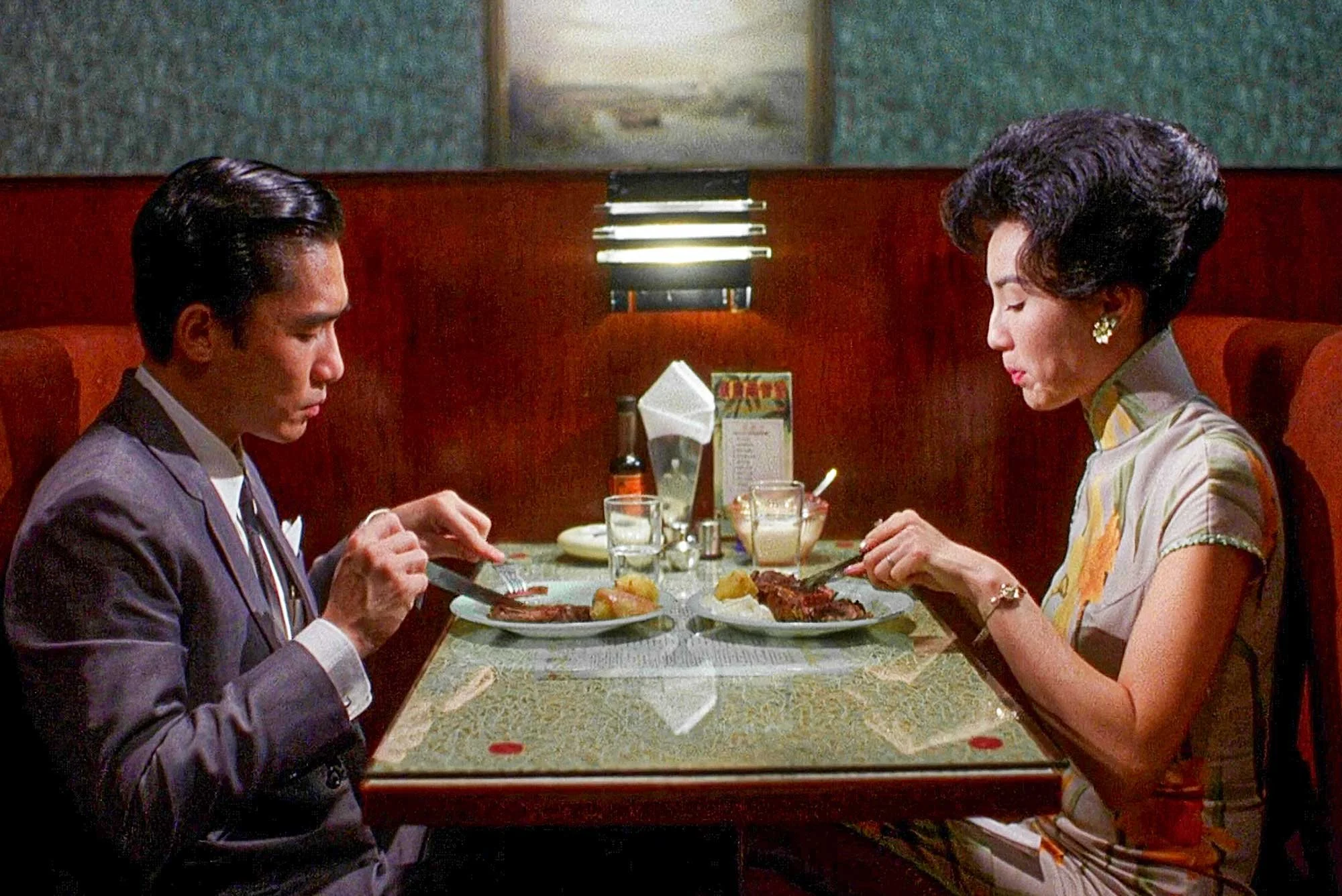
In the Mood for Love (2000), Wong Kar-wai. Image courtesy of Hollywood Authentic.
While films around the world are praised and remembered for the morals and messages they convey, visual intentionality is one of the most effective ways for a film’s following to expand. Visual intentionality can be created through a single idea, or through an iconic motif a director grows to be recognised for, ranging from camera angle and manipulation, colour grading, breaking the fourth wall, etc. Three directors in particular have mastered the creation of visual intentionality, which has ensured that their films and their lessons remain relevant: Wong Kar-Wai, Christopher Nolan, and Bong Joon Ho.
Wong Kar-Wai is one of the most famed directors of all time, his catalogue including classics such as In the Mood for Love, ChungKing Express, and Fallen Angels. His distinctive cinematographic style and colour grading are a staple of all three, but one of his most recognisable facets is the combination of step-printing and slow shutter speed used to distort time. All three hold a distinctive colour grading: In the Mood for Love features more stilled, slowed cinematography, while ChungKing Express and Fallen Angels are known for having fast-paced step printing and shutter speed. These manipulations change the presentation of the storyline with the time around the characters seeming to pass in a confused and disfigured blur, or, in the case of In the Mood for Love, the passage of time is painstakingly clear for the ill-fated lovers. Wong Kar-Wai is known for how he exaggerates his colourful time, immersing the audience into what his characters perceive as an amalgamation of love and time. Love is complex and confusing, yet happily overpowering, and the blurred, quick tempo in ChungKing Express and Fallen Angels articulates those emotions. In comparison, In the Mood for Love’s manipulation of time is an analogy for different timelines, consisting of slowed frames in the corridor scenes where Chow and Su only ever pass one another: their distorted time never allows them to be together, and they are the only couple in the three films who do not have a hopeful end.
The conclusion of Christopher Nolan’s Inception falls to audience discretion; this lingering form of open-ended audience engagement is one of the reasons the film is beloved. The ending of Inception sees Cobb successfully re-entering the United States after completing his last dream security mission, finally reuniting with his children. However, the totem Cobb uses to distinguish reality from dream is his spinning top, and if spinning and the top falls, he knows he is back in reality. The last scene shows Cobb embracing his children, the camera moving to focus on the top, where the audience sees it slightly falter before continuing to spin, and then the screen cuts black. There is no further hint as to whether the top fell or continued to spin, the truth somewhere beneath the black of the screens and credits. Thus, the true nature of Cobb’s fate, if he is lost somewhere underneath a layer of dreams or if he is conscious in reality, is missing. The audience is left with the task of deciding the sincerity of Cobb’s new life, happy with his family or imagining them.
Another one of Christopher Nolan’s iconic end shots is in the 2023 acclaimed film Oppenheimer, which follows the story of J. Robert Oppenheimer, who oversaw and calculated the creation of the first atomic bomb. While the film shows the process and the strain that Oppenheimer endured to create the bomb, it also illuminates the consequences of the destruction that affected both the world and Oppenheimer. The end scene shows Oppenheimer consulting Einstein, telling him that he believes his calculations and the consequential construction of the bomb have destroyed the world. Scenes in between their discussion centre around showing the modern-day technology and effects from continued atomic bomb and nuclear production. When the images and the guilt become too much for Oppenheimer to continue to endure, he shuts his eyes, and the screen turns black with his vision. Oppenheimer shutting his eyes illustrates that even though he was partially responsible for the creation, the evil in his weapon was clear, and earlier sequences showed his remorse and action to halt nuclear reproduction. There is nothing more Oppenheimer can do: shutting his eyes and the darkness looming over the audience is symbolic to show that people now must end what Oppenheimer started.
Memories of Murder (Bong Joon Ho) is perhaps the ending scene that haunts me the most, principally as it is based on the true Hwaseong serial murders from 1986-1991, deemed a cold case for decades. Memories of Murder is the story of three detectives in a small town trying to catch a serial rapist and murderer. The detectives come close to unravelling the mystery by decoding a series of clues the murderer used to decide when to act, but when they finally catch the man they believe responsible, they are forced to free him due to inconclusive evidence. The final death the audience sees is that of a schoolgirl who helped the detectives try to solve the case, her fate sending the detectives spiralling. After her murder and the release of the culprit, a time jump shows the audience that the case’s main detective Park Doo-Man has left the force, yet the audience watches him return to the site of the first murder to check that there are no more. A new little girl sees him and tells him a strange man did the same thing a while ago, telling her he said he did something there a long time ago, and he came to take a look. Detective Park asks if the girl saw his face, which she did, but she has no notable way of describing him other than as ‘ordinary’, her lingering word a dead-end for the cold case. The final shot shows Detective Park turning from looking at the girl to staring into the camera, the scene going dark. The final act of the film shows Detective Park looking into the audience as a representation that the killer is among the public. He looks ordinary and thus a man no one would expect. The shot is intended to illustrate that even though he is lost among the people, the existence of the killer is known, and only a matter of time before he is found. A delayed sense of peace was brought to the public in 2019 through the ‘ordinary’ man’s capture and imprisonment. However, even after his arrest, Park’s eyes are intended to haunt the audience and haunt the killer, a reminder of the evil that can be concealed through something society deems ordinary.
Wong Kar-Wai, Christopher Nolan, and Bong Joon Ho have used an array of visual internationalities to ensure that the lessons in their films remain with the audience long after viewing. Wong Kar-Wai explores how colour grading and manipulation of time can be conveyed to portray love in all its forms: obsessive, ill-fated, mutual, etc. His colour and time choices illustrate how love feels overpowering and overwhelming, and distorts our perception of reality and our surroundings. Christopher Nolan allowed for his final shot in Inception to rely on the audience’s interpretation of reality, while Oppenheimer's last scene sees Oppenheimer close his eyes due to the consequences of his creation. The ending of both falls onto the audience: in Inception, the question of whether reality should be probed if it affords us our loved ones or if we should live in bliss, and in Oppenheimer, a call to action on the people to combat the consequences of nuclear power. Finally, Bong Joon Ho’s Memories of Murder remains with the audience in the last shot of Detective Park’s knowing stare into the audience. His eyes are intended to convey the emotion of the entire film, and more importantly, the case in real life: while at the time the killer remained loose, he would be caught, but the audience also needed to understand the dangers of what appears as an ordinary and evil man among them. These directors and movies will always remain in my high regard, for the purposeful messages they are able to deliver through their motifs and sequences, but especially for the meaning behind their visual intentionality.