
‘To Dundee City Council’ - the Vanity of the V&A
BY JENNIFER GREENE
“My shameful vanity? I thought you might
take time, this time, to personalise the slight.
Know at least I leave here with my tail
between my legs again, and setting sail
for that fine country called the fuck away.
Farewell! Good luck with the V&A.” (Don Paterson, 2015)
Source: Tripadvisor
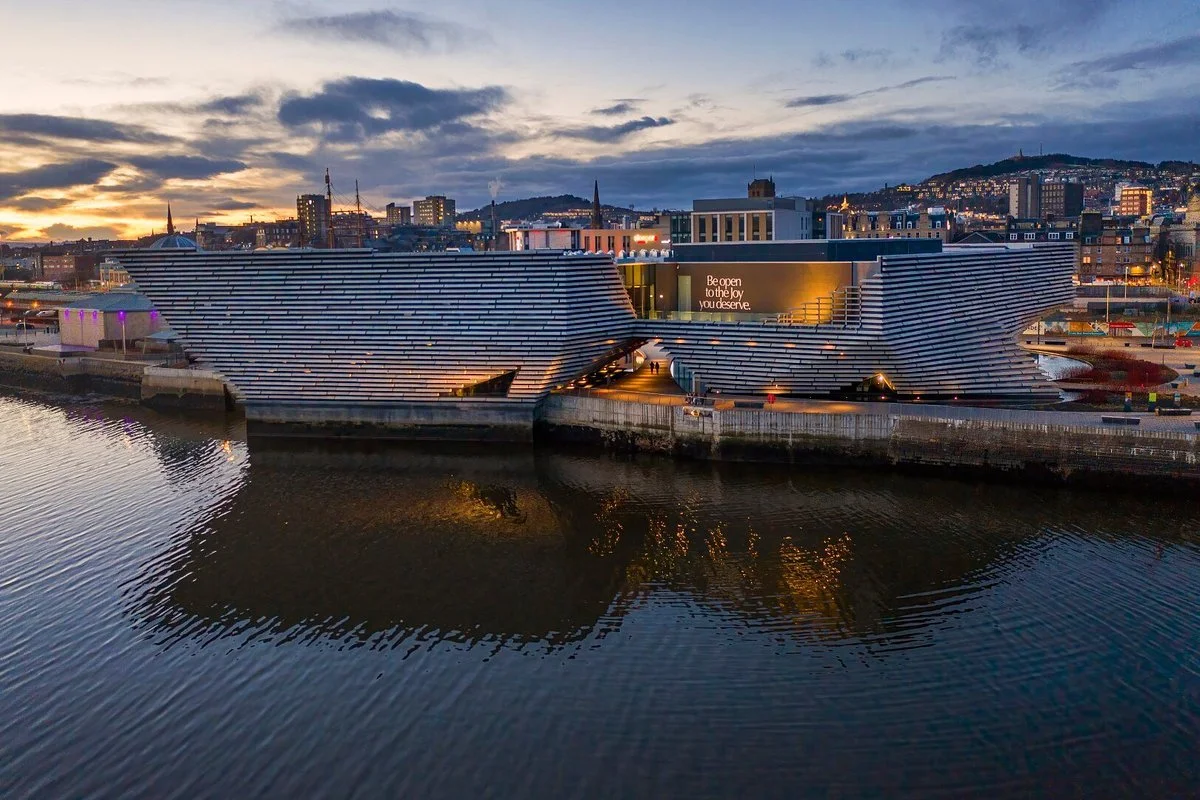
This sonnet by Dundonian poet Don Paterson has stuck with me since I studied it in first year. In this stanza of To Dundee City Council, Paterson links vanity with the V&A: the £80m design museum that opened in 2018. It hosts a variety of local and global artwork and is felt by many as a source of pride for the city, yet it is simultaneously met with heavy criticism from a multitude of voices, including Paterson’s. I argue that this is justifiable, as the V&A is emblematic of a wider debate around vanity projects in Scotland. Yet, it is also worth exploring the positive economic, social and cultural impacts of the V&A on the city.
The V&A was designed by renowned Japanese architect Kengo Kuma, who was inspired by the appearance of jagged Scottish cliffsides. The museum, which overlooks the moody grey blanket of the Tay, has become a Dundonian architectural and artistic landmark. It is Scotland’s first design museum and has put Dundee on the global stage for ‘creative innovation and excellence’ . Anyone who attends this University who has realised that Market Street isn’t representative of the whole of Scottish culture will appreciate the V&A’s diversity of political voices and artworks. Local communities contribute art about relevant issues: I recall seeing exhibitions about mental health, disability activism, and women’s rights, which were mostly created by local young people. The museum functions as a social and educational space, working with the Amina Muslim Women’s Resource Centre to deliver inclusive museum tours in Arabic, Hindi and Punjabi. Among its exhibitions, you’ll also find Vivienne Westwood tweed and a Jacobite garter from the 18th century. At its opening, the V&A was expected to provide the city an annual economic boost of £11.6m, alongside 270,000 visitors yearly (Good Causes, n.d). However, the V&A at Dundee has faced criticism from the beginning—even before it received its first visitor.
The V&A was intended to be ‘the living room for the city,’ as if to imply that people should take artistic refuge from the streets. In many ways, the high-art of the V&A, with its striking architecture, is an insulting contrast to the reality the city faces: Dundee is a city in which 31% of children live in relative poverty. Statistics from this year show that Dundee had 350 drug related incidents that were violent and/or fatal within three months, and that the number of near-fatal drug overdoses rose by 70% in a year. Dundee does not need another art museum as much as it needs infrastructure that will tackle the impacts of drug abuse. £6.5 million were drawn from the city council’s budget to construct the building, which has been criticised in The Guardian as a ‘flawed treasure house’. Its opulence shines a bright light on the neglect of Dundee’s people by the council. To define something as a vanity project, one must observe a causal connection between the funds used in construction and the detriment to the surrounding communities. This is not necessarily the case with V&A, as it productively engages with artistic communities. However, this is also not an antidote to Dundee's housing issues or its drug crisis. It is difficult to prove that the V&A itself is causing or exacerbating deprivation in the city, yet it is clear that the council funding was diverted from a more essential cause.
Vanity projects are a common theme across Scottish city councils. Glasgow, my home city, is the drug capital of Europe. In 2025, Glasgow City Council decided to refurbish George Square, costing over £115 million in government funding. Yet, the city council actively struggles to afford essential homeless shelters– Homeless Project Scotland is the only night shelter available to Glaswegians in the area. I see this as an obscene waste of government resources. Glasgow is the most populated city of a country in which 1.1 million people (20% of the population) live in relative poverty due to the rising cost of housing between 2021-2024. While both Dundee and Glasgow face similar socio-economic issues, neither city’s council is effectively using its funding to solve them.
The V&A is not just controversial because of its use of resources; countless visitors have decried the building for its architectural failings. Externally, it is aesthetically pleasing, but inside, it is irresponsibly organised, oddly distributed, and lacking in spatial purpose. Unlike most of this country’s museums, only a third of the gallery space is free to enter. Likewise, only two floors are accessible to the public, and they are taken up largely by a restaurant, a cafe, and a gift shop. Public reviews of the V&A frequently feature the word waste – either referring to a waste of time or a waste of space – pointing towards a public consensus of disappointment. For a structure that requires £3 million a year to run, the V&A does not maximise its facilities, which limits its potential to positively impact the city.
This issue has no straightforward answer. The V&A has brought genuine positive effects on the community, bringing people together to celebrate art. However, the mental disconnect between the funding pouring into the museum and the pressing issues affecting the city suggests that the V&A may have been a vanity project from Dundee City Council. This same phenomenon is occurring in Glasgow, which I regret; I already know that when George Square re-opens, it will still consist of uninteresting slabs of concrete outside of Queen Street Station. While art museums are an incredible way of inspiring a community, we have to be conscious of where our limited funding can best be spent, and secondly, that our efforts towards promoting arts and culture actually enriches people's lives.