Up in Flames: In Appreciation of David Lynch
By Sofia Melka
The entire floor thrums with an ominous hum. It’s thick with it.
Eerie. A screen swarms with thirteen minutes of ants crawling over a chalk-white humanoid face. A video installation of a desolate, futuristic landscape emits thud after thud after thud.
Liminal. A labyrinth of concrete walls and slanting floors. High ceilings. A deep and bright orange covering the walls. Charcoal grey everywhere else.
I scrawl a few things on my exhibition ticket as I look around. Seems like he was stuck in a dream. A real dream. One-foot-out-of-the-bed, tossing, turning, sighing, crying-out-in-your-sleep-just-to-wake-up-and-forget type of dreaming. Sort of artist who requires his own vocabulary is another note. And then, I suppose as a concession: enigma is a good word for him.
‘OPPOSING PATHS MUST MEET SOMEWHERE’
Motto of DOX Centre for Contemporary Art
From June 2025 to February 2026, this ‘somewhere’ happened to be David Lynch’s exhibition, Up in Flames. Over 400 pieces of Lynch’s visual art, carefully curated by Otto M. Urban, were displayed in Prague’s DOX Centre for Contemporary Art. A collaboration with the David Lynch Estate and Item éditions, the drawings, photography, lithographs, watercolours, and short experimental films of Up in Flames made up an unsettling but unabashed ecosystem. The displayed works ranged from the late 1960s until his passing in 2025. Lynch is best known for his filmography, including, though certainly not limited to, Twin Peaks (1990), Eraserhead (1977), Blue Velvet (1986), Mulholland Drive (2001) and even an adaptation of Dune (1984). He presents us with a body of work so distinct that it begs for its own adjective. As I wandered through the exhibition, I came to understand how his visual art serves as a foundation for the rest of his oeuvre. Lynch's vast array of mediums and techniques across Up in Flames is a testament to his ever-evolving artistic practice.
I had the fortune of visiting Up in Flames twice: once in the summertime, once in the winter. Both times, I felt like I was wandering into a maze; viewing Lynch's work against the sparseness of the gallery was an almost hallucinogenic experience. These pieces, alongside a few words from the artist, interrupted solid charcoal and deep orange walls. One wall featured this opinion on style and semantics:
‘I hate slick and pretty things. I prefer mistakes and accidents. Which is why I like things like cuts and bruises – they’re like little flowers. I’ve always said that if you have a name for something, like “cut” or “bruise,” people will automatically be disturbed by it. But when you see the same thing in nature, and you don’t know what it is, it can be very beautiful.’
In a dark little room off to the side, I sat and watched a selection of Lynch’s short films. One of the films from the reel, Idem Paris (2013), was a black-and-white documentary shot in the Idem Paris studio – an important venue for international artists venturing into the world of lithography. Shaky zooms. Lingering shots of rotating gears and intricate machinery. The shuffling of slick prints. It was a pleasure to watch this process through Lynch’s gaze, witnessing his encounter with yet another medium.
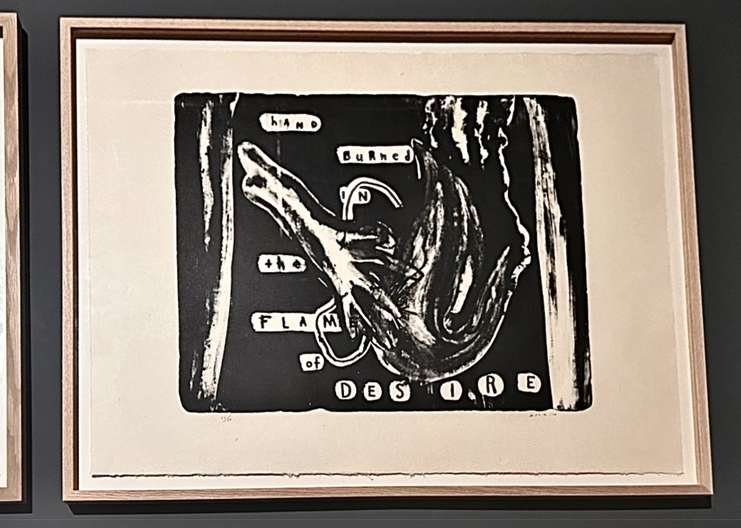
HAND BURNED IN THE FLAME OF DESIRE (1974)
Hand burned in the flame of desire. 2 women lift fish by tree. Thoughts of man of woman.
These are a few phrases which appear across Lynch’s collages– all sparse in their language and blunt in their tone. Some poetic, some self-evident. The romantic sigh of a phrase, ‘thinking of you’ accompanies a drawing of a man holding a gun to his head. Even at his darkest, Lynch never loses his sense of humour. These inscriptions come in jagged letters of varied size, shape and capitalisation. This lack of typographic consistency lends the collages an air of childlike play; the effect is nearly that of an arts-and-crafts project. These inscriptions are incorporated into the pieces’ visual landscape, thus defining their interpretation. Lynch’s instinct to describe his art so explicitly reminds me of a child's eagerness to label a whirlwind of tangled lines and abstract shapes as 'mum,' 'dad,' and 'me.' The contrast between the text's childlike simplicity and Lynch's dark subject matter adds a fascinating dimension of irony to his work.
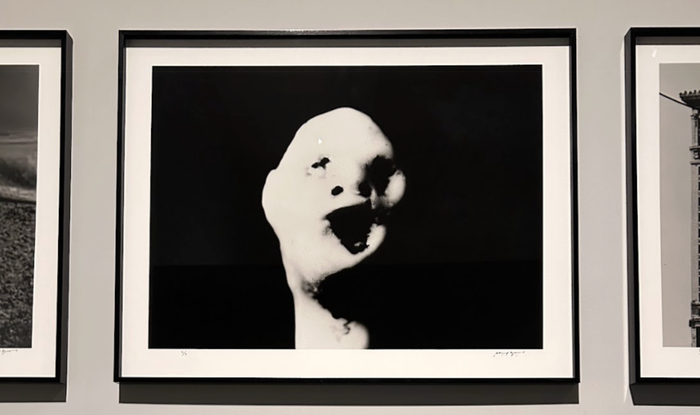
MAN LAUGHING (2013)
As an observer, I felt Lynch pushing me to invent and reconsider throughout the exhibition. It’s not light work. Lynch demands that you notice, as he does, the currents of beauty in something dark, as well as the dark underbelly of something beautiful. ‘Enigma is a good word for him.’ Across his many mediums, Lynch’s art consistently exists in a state of paradox. We are always seeing double, whether it be in pairs, duplications or divisions. Shadow & light. Pain & relief. Comfort & disruption. Tension & release. Pure & vulgar. Erotic & mundane. Body & mind. Sick & sweet. Simple & twisted. Nightmare & dream.
DOX’s motto comes to mind again: ‘Opposing paths must meet somewhere.’ Across the exhibition, we observe duality as a natural fact of the human condition. In one series of photos, the nakedness of the human body is cinematic. In the next, it’s grotesque. That titular motif of a fire or flame signifies both vital passion and mortal destruction. Commenting on a series of shadowy photographs of abandoned factories, Lynch states that to him, these structures are ‘like cathedrals.’ Industrial landscapes are portrayed as sites of both desolation and reverence.
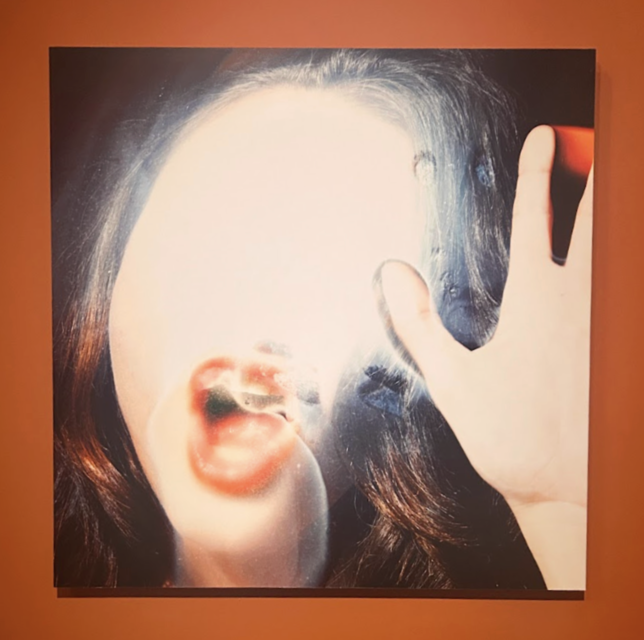
EMILY SCREAM ! (2008)
Lynch seems to offer us not only a way of seeing, but a way of being. In finding something simultaneously sick and beautiful, he demands us to constantly reconcile paradoxical truths. The hand burned in desire’s flame is surrounded by darkness. It’s physically punished with scorched skin and visually distorted in its eagerness, and yet it’s still glowing white-hot in lively passion. His swarming ants are disturbing, but by the thirteen-minute-mark, the steady stream of insect legs seems to caress the strange, face-like surface. Somehow, it becomes loving. I’m reminded of an often-misattributed quote from Cesar A. Cruz: ‘Art should comfort the disturbed and disturb the comfortable.’ In his constant contradictions and reconciliations, Lynch leaves us with a funny feeling of dissonance. With it comes a confrontation: why are we moved towards any one interpretation, and not its opposite? What deserves our attention, and what is worthy of being called beautiful? A Lynchian world, where things are both beautiful and strange, opposite and true, offers no other option but to reflect, and ultimately – hopefully – to widen our eyes, seeing as Lynch might have.
‘It's like I'm having the most beautiful dream... And the most terrible nightmare, all at once.’
Twin Peaks, Season 1 Episode 2, ‘Traces to Nowhere’
David Lynch passed away on the 16th of January, 2025.
Urban’s curation of Up in Flames paints a superlative portrait of an artist, revealing the late Mr. Lynch to be singular– singularly dreamy, nightmarish, comforting, disturbing, and wholly unabashed. The exhibition makes clear his indiscriminate curiosity, his playfulness, and his career-long exploration within and certainly beyond his best-known medium. Anyone with any interest or disinterest, curiosity or appreciation, understanding of or apathy towards David Lynch, in any of his many forms, ought to give his art a look. With Lynch, you never know what you might find– into which nightmare you might fall, or from which dream you might wake.