
La Bohème: ‘My treasure is stolen by a pair of beautiful eyes
La Bohème: ‘My treasure is stolen by a pair of beautiful eyes’
By James Carder-Geddes
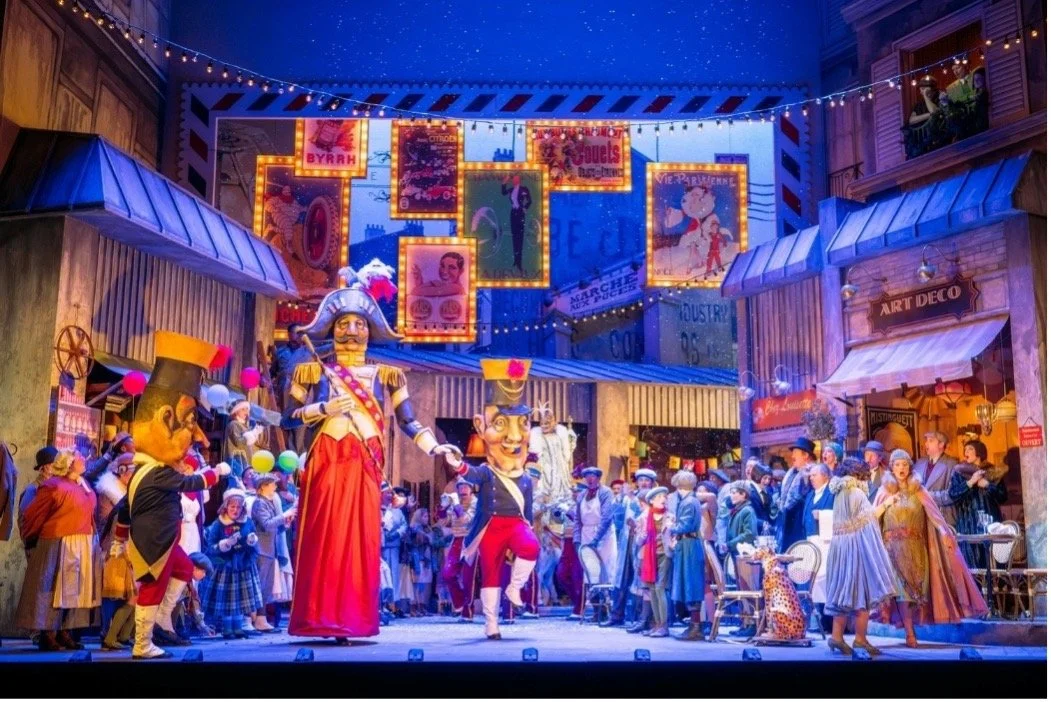
Photo credit: Mihaela Bodlovic, Scottish Opera
There’s a painter, a poet, and a philosopher in an attic… this sounds like the start of a joke, but this is in fact the opening scene of Puccini’s opera, La Bohème, set in 1830s Paris. And a very cold Paris at that. Living in Scotland, we can appreciate the state of chronic gelidity in which Rodolfo the red-nosed poet and his friends find themselves at the start of the opera. Feeling cold is something one has to get used to in the world of La Bohème, with an operatic ecosystem that parallels Antarctica. Luckily for me, the cushioned seats of the Festival Theatre, Edinburgh, provided ample warmth. Coldness also has a symbolic significance in La Bohème; it represents a biting loneliness, lack of hope, and ultimately death. Coldness is the inspiration too for my favourite aria in this opera – ‘Che gelida manina’ – or “what a cold little hand,” where Rodolfo woos his neighbour Mimì after their hands accidentally touch in the dark. If you want to watch the best version, find the 1986 Genoese Opera production with Pavarotti as Rodolfo. I’ve always found it somewhat strange that Rodolfo, after only having known the flustered, ill Mimì for a few minutes, launches into a song about his love for her all within the space of one night. Can you imagine if modern romance were like this – clearly, the suspension of disbelief is something we have to get used to in La Bohème.
Rodolfo and Mimì head to join the others at the quintessentially French café Momus. At the Scottish Opera production, Barbe’s wonderful set was bursting with vibrancy and colour. There were giant figurines parading the street, strings of Christmas lights, and a lively chorus of children hopping around playfully. I think we can all share the excitement of Christmas Eve, and this production has got me singing Aranci, datteri! Caldi i marroni! ("Oranges, dates! Hot chestnuts!”) all the way through exam season. La Bohème has one of the very few perfect scores – every note, every bit of orchestration, and the interplay between voice and orchestra, is perfect, and you can never forget this when watching. Marcello spots his ex-girlfriend Musetta swanning about with her new lover, Alcindoro. The great sequence that follows involves Musetta jumping on the table, running around the street and singing her risqué song Quando me'n vo'—"When I go along.” Musetta loves to be the centre of attention, and I think it is fair to say that she earns the audience’s attention with her aria, which contains ‘the high B’ – an impressive feat for any soprano.
Months later, Marcello and Musetta are back together, staying at an inn, and Mimì arrives, looking her worst. She approaches Marcello and tells him that Rodolfo abandoned her the night before due to his terrible jealousy (O buon Marcello, aiuto! - "Oh, good Marcello, help me!"). She overhears a conversation between Rodolfo and Marcello about her coquettishness, but also that Rodolfo fears she is a victim of consumption (TB). After weeping and coughing, her hiding place is revealed, and then she suggests that she will leave him (Donde lieta uscì—"From here she happily left"), but their love is too strong for them to part, and they agree to stay together until spring. This ends with a brilliant quartet between the two and Marcello and Musetta (arguing about her flirtatiousness). Some months later, we are back in the garret with the bohemians who are talking about the girls, when suddenly Musetta arrives with Mimì, who is dangerously ill and desperate to see Rodolfo. Everyone scrambles around trying to find things to raise money for a doctor. This leads to a whole aria given by Colline (the philosopher) about giving up his coat (Vecchia zimarra). I had to look twice when I was watching a man singing a funeral dirge about his coat!
In the most touching scene of the opera, Mimì and Rodolfo – left alone – confess their love again, with Mimì singing ‘Che gelida manina’ in a haunting echo. Mimì’s fate – death – was sadly inevitable as the cry of Rodolfo, “Mimì!” echoed agonisingly around the opera theatre. What followed was a sudden plunging silence, which gave way to a final poignant orchestral passage, as the group huddled around the sofa with Mimì’s dead body strewn (it reminded me of Wallis’ The Death of Thomas Chatterton). Positioned like mourners around a funereal casket, the friends dispersed upstage, their backs to the audience, and heads down. In a chilling final vignette, a spotlight as incisive as the dagger plunged into all of our hearts, beamed down on the empty sofa, with no Mimì to be seen.
So – what’s my point? Well, opera is not some antiquated, high-culture, elite interest that attracts only bald OAPS with a pension high enough to anger Rachel Reeves, but rather something for young people too. Especially La Bohème, whose very plot centres around a young group of friends – this could be you or me. Café Momus could be 601, Rodolfo and Mimì could be the two lovebirds in JBH, Musetta could be that girl in the cheerleading team, Schaunard could be that overly dramatic kid who does acapella, the streets of Paris could be Market Street at Christmas, and so on and so forth. The point I am trying to make is, no matter how far back in history an opera is (1830s), no matter how locationally distant we are as an audience (Paris), no matter how great a linguistic barrier there is (Italian – although helpfully surtitles are provided in English), we can still appreciate its relevance to us, as students at a Scottish coastal university. This is true of any art, but for me, opera has a unique way of transcending linguistic boundaries; it really is a vital expression of humanity.
It’s not just the actors on the stage, the orchestra in the pit, the set designers, the wardrobe mistress, the producer, or even director, but also the operatic triumvirate – in the case of La Bohème - of Illica (who crafted the plot), Giacosa (who turned it into poetry), and Puccini (who elevated it through his music). I would put it to you, if you’ve never watched an opera before, to watch La Bohème – it truly is the best place to start! But don’t go along expecting it to be predictable (although my apologies for going through the entire plot!), or ordinary as, in the wise words of W.H. Auden, "No opera plot can be sensible, for people do not sing when they are feeling sensible."